


NSGA non-dominated genetic sorting algorithm
The objective of thegenetic algorithm NSGA nondominated sorting is to improve the adaptive fit of a population of candidate solutions to a Pareto front constrained by a set of objective functions. The NSGA nondominated sorting genetic algorithm uses an evolutionary process with surrogates for evolutionary operators including selection, genetic crossover, and genetic mutation.
The population is ranked in a hierarchy of subpopulations based on the order of Pareto dominance. The similarity between members of each subgroup is evaluated on the Pareto front, and the resulting groups and measures of similarity are used to promote a diverse front of nondominated solutions.

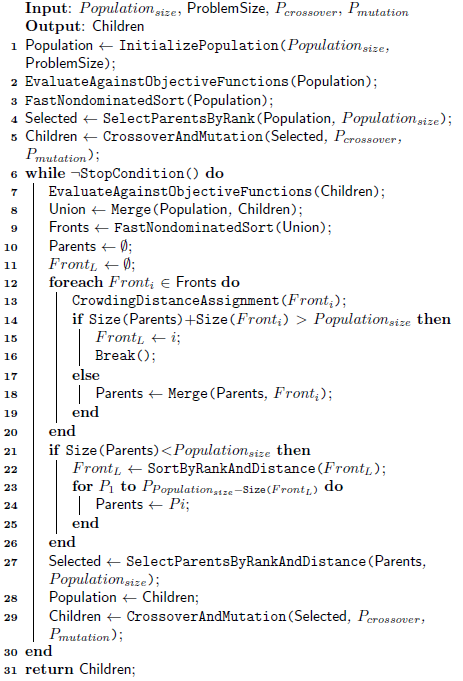
The SortByRankAndDistance function sorts the population into a hierarchy of non-dominated Pareto fronts. The CrowdingDistance-Assignment calculates the average distance between the members of each front on the front itself. The Crossover-AndMutation function performs the classic genetic algorithm crossover and mutation operators. The functions SelectParentsBy-RankAndDistance and SortByRankAndDistance first discriminate the members of the population by their rank (dominated priority order of the edge to which the solution belongs) and then by the distance inside the edge (calculated by CrowdingDistanceAssignment).
The NSGA non-dominated sorting genetic algorithm was designed and adapted for instances of continuous function multi-objective optimization problems. A binary representation can be used in conjunction with classical genetic operators such as point crossover and point mutation. A real-valued representation is recommended for continuous function optimization problems, in turn requiring representation-specific genetic operators such as simulated binary crossover (SBX) and polynomial mutation