Queue M / M / 1
An M / M / 1 queue follows an exponential law for arrival and customer service. An M / M / 1 queue is shown as follows.

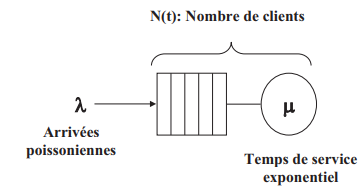
In the majority of cases, the customer in a service is included in the number of customers in the queue.
The number of customers in the queue is modeled by the markov chain following continuous time:

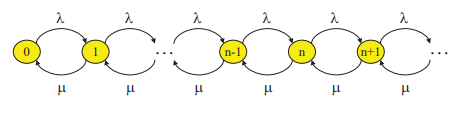
Stationary probabilities exist because the chain is irreducible. Denote by p (n) the probability that the number of clients in the queue N (t) = n as t tends to infinity. The equilibrium equations give the following system:

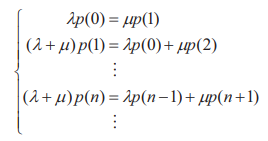
If we set ρ = λ / μ then we find p (n) = ρnotp (0), which implies:

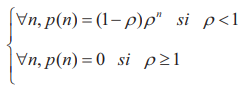
We deduce that the queue is stable if ρ<1. This means that the average processing time for a customer is strictly less than the average arrival time for a customer (ie the average time between 2 customer arrivals). The queue is unstable if ρ≥1, in which case customers accumulate ad infinitum in the queue.
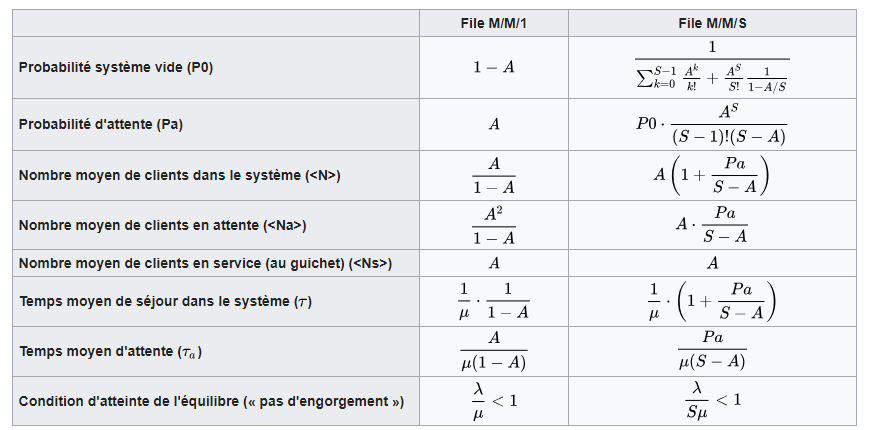
All the performance parameters are calculated in steady state if the queue is stable. If we apply Little's law and the performance measures to M / M / 1 queues (and more generally to M / M / S queues), with ρ = A: