PERT method
Task information is summarized in a schedule like the following example:
|
task
|
precedence
|
duration
|
|
TO
|
–
|
6
|
|
B
|
–
|
5
|
|
VS
|
TO
|
4
|
|
D
|
B
|
6
|
|
E
|
VS
|
5
|
|
F
|
A, D
|
6
|
|
G
|
E, F
|
4
|
Step 1: construction of the graph from the schedule
- PERT method – Determination of task levels:
We will assign the level 0 to tasks that have no prior task.
We will assign the level 1 to tasks whose previous tasks are level 0.
We will build the graph by plotting the tasks in ascending order of level.
- PERT method – Beginning, ending, convergent tasks:
Before embarking on the construction of the graph, it will often be useful to detect the so-called starting, ending or converging tasks.
terminal vertex of the graph.


It is important to place the tasks in order of execution. Task F can only be placed once task TO and D placed, and the task D can only be placed after the task B. This explains the fictitious edge between 2 and 5 (TO and at a distance 1 while F is in the distance 3 from the start).
Step 2: determine the dates and margins
Once the graph has been constructed, we will determine the dates at the earliest and at the latest for the
different vertices and free and total margins for tasks.
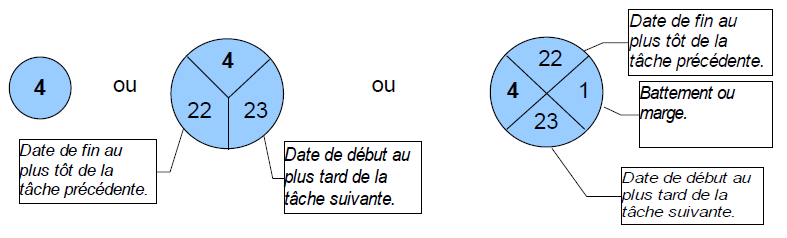
- PERT Method – Earliest Dates:
For a summit, the earliest date (noted: t) represents the minimum time needed to reach this peak. It will be determined step by step, in order of increasing vertex, from the input of the graph, thanks to Ford's algorithm for finding the longest path.
Thereby :
t1 = 0 and tj = Max (ti + dij ) on all i preceding j withij = time between peak i and j.
In the example, t1 = 0, t2 = 0 + 6 = 6, t3 = 0 + 5 = 5, t4 = 6 + 4 = 10, t5 = max (6 + 0, 5 + 6) = 11, t6 = max (11 + 6, 10 + 5) = 17, t7 = 17+4 = 21.
The earliest date of the graph output represents the minimum duration achievable for
the entire project (in the example, t7= 21, so the project will last 21 days at best).
- PERT Method – Latest Dates:
For a summit, the latest date (noted: T) concretely represents the date on which this state must be reached if the total duration of the project is not to be increased. It will be determined analogously to t, but in descending vertex order, from the graph output to the input.
Thereby :
Tnot = tnot = Duration of the project and Ti = Min (Tj –dij ) on all j preceding i.
In the example, T7 = 21, T6 = 21 – 4 = 17, T5 = 17 – 6 = 11, T4 = 17 – 5 = 12, T3 = 11 – 6 = 5, T2 = min (11-0, 12-4) = 8, T1 = min (8-6, 5-5) = 0.
We will always have t1 = T1 = 0 and t less than or equal to T for any summit. We call Tt la
top float margin.
- PERT method – Task margins:
The slack of a task represents the maximum possible delay of a task without delaying the start of subsequent tasks, note ML. The total margin of a task represents the maximum possible delay for the realization of a task without delaying the whole project, it will be noted MT : MLij = tj -ti –dij and MTij = Tj -ti –dij.
Given the calculation mode, the margins will always be positive or zero and the free margin of a task will always be less than or equal to its total margin.
We will qualify as critical, a task whose total margin is zero. A critical task should not be delayed if the total duration of the project is not to be increased.
If the duration of a non-critical task increases, part of this increase will be absorbed by the slack of the task, only the surplus will affect the duration of the project.


Aside
Vertices can contain several pieces of information at the same time: